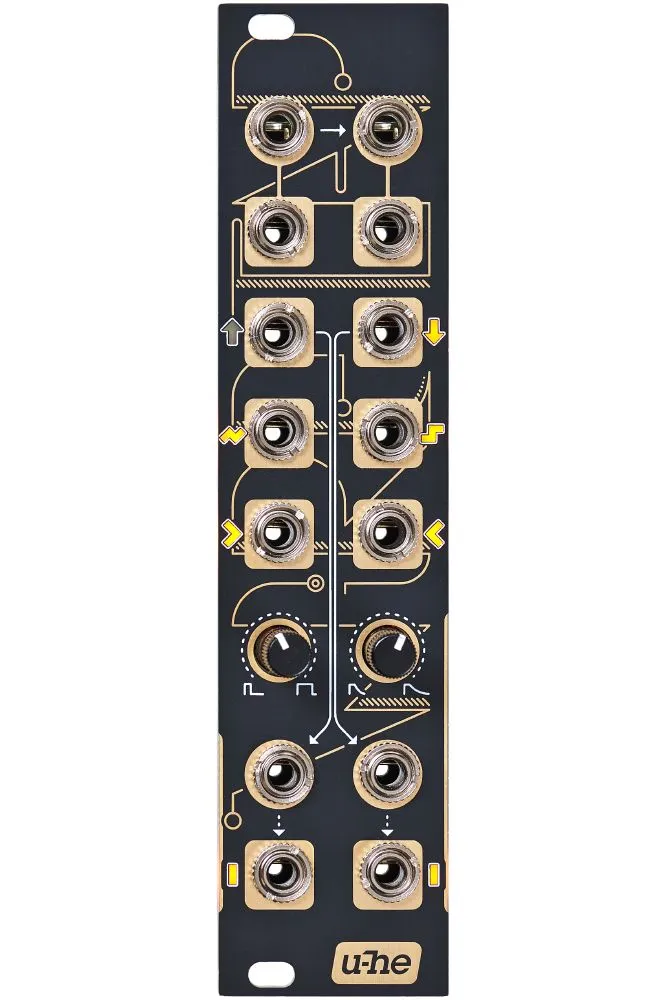
u-he - CEN2RION


€399.00
Net: €335.29
In stock
| U | 3 |
| HP | 14 |
| Depth | 42 |
| +12V | 160 |
| –12V | 120 |
U-he's Cen2rion — A 6-Channel Scanning Mixer with Dual Layers, AUX Tricks, and More Than a Few Routing Surprises!
U-He’s Cen2rion is a six-channel scanning mixer with individual attenuators and six DC-coupled inputs, equally happy with audio and CV. Two layers, A and B, share the same six inputs but mix to separate mono outputs, which makes Cen2rion more than just a summing stage — it’s a router that can reconfigure itself in motion.
Scanning mixers might look unassuming at first, but once you get to know how they work, they might open up a whole new set of use-cases you might not have thought of before. They all have their own approach, and Cen2rion definitely has its own unique idea of this concept. Instead of static level knobs, you use two controls per layer: SELECT chooses the channel focus, WIDTH broadens it to neighboring inputs. Think of it as sliding a window across your sources, smooth and click-free thanks to a vactrol-style release curve.
In DUAL mode, Layer A and Layer B are completely independent — each output is determined only by its own controls and CV inputs. In LINK mode, B follows A with bipolar offsets, which makes it easy to turn six mono sources into a stereo field. SPLIT mode divides the inputs into two groups of three, letting A handle 1–3 and B handle 4–6, handy for stereo pairs or parallel routing.
Cen2rion doesn’t care if it’s audio or CV. You can sweep through oscillator waveforms, dynamically decide which voices hit an effect, or even scan a set of modulation sources to drive something else in sync with your mix. Every parameter has a CV input with attenuverter, so you can automate the scanning in detail.
The AUX sockets extend the design: switch them as inputs to feed extra signals directly into the mix, or as outputs to pull fixed submixes of channels 1–3 and 4–6. It’s a small detail that makes Cen2rion equally useful as a central mixer or a patching utility.
One important thing: the front panel is symmetrical, and the graphic on the back of the panel is inverted. So you can choose between a silver or black panel - just be careful when changing it so you don't scratch it ;)Features:
- 6 inputs with individual attenuators
- 2 layers (A & B) with independent outputs
- 3 modes: DUAL, LINK, SPLIT
- Smooth or discrete blend options
- Layer B invert mode (selection becomes exclusion)
- Full CV control of SELECT and WIDTH with attenuverters
- AUX jacks configurable as input or output (rear switch)
- Handles both audio and CV signals (DC-coupled)